Something mysterious and incredible happened around September of last year. Coding agents got really good. Like really, really good and the pace hasn’t slowed. We saw the inflection point in agentic coding early and have transformed every aspect of how we approach software engineering and how we run Continua as a result.
We are now working to bring what we’ve discovered to the world in the form of an opinionated agentic development OS and service runtime. We have named this product Wheelie (sign up there!), and we’d love for you to try it.
Today you can subscribe to spin up VMs and develop on them, starting with the workflow developers already have: existing repos, terminal agents, isolated working copies.
Our goal is to reinvent the entire software development life cycle, from source control on up, to leverage this sharp technological discontinuity we are in. No one knows where the models will be in two years let alone the end of this year. But we are incredibly bullish and are developing the processes that enable us to close the loop as quickly as possible. Wheelie is not trying to replace your agent. It is trying to make agents trustworthy at team scale: source isolation, typed status, recovery, submit/watch, and attention routing around the work they produce.
Wheelie starts with a narrow, useful loop: hand an issue from a repo to Pi/Claude/Codex/your harness, get a working copy, review the diff, and run typed validation evidence before trusting the result. In practice, that means: fix one backlog bug while you’re in meetings, run three agents without trashing your checkout, or get notified when an agent is done, blocked, or waiting on you.
Wheelie is decidedly non-waterfall-style development. You don’t plan and walk away – that doesn’t work for anything non-trivial (an observation made also by others). Instead, you dialogue on architecture and goals, tradeoffs. Wheelie handles questions of what language to use – you, the experienced engineer, have the back and forth with the agent on what consensus algorithm is needed for certain scale.
The larger arc is a service runtime, handling deployment, WorkGraph decomposition, and team-scale coordination: Wheelie should break big goals into bounded chunks, route them to agents, surface blockers, and help humans attend to decisions rather than babysitting terminals.
In recent months, our team has been landing hundreds of agent-assisted changes per day. The bottleneck stopped being “can we write code?” and became “can humans validate, coordinate, and safely land the work?” Does this graph look like you or your team?
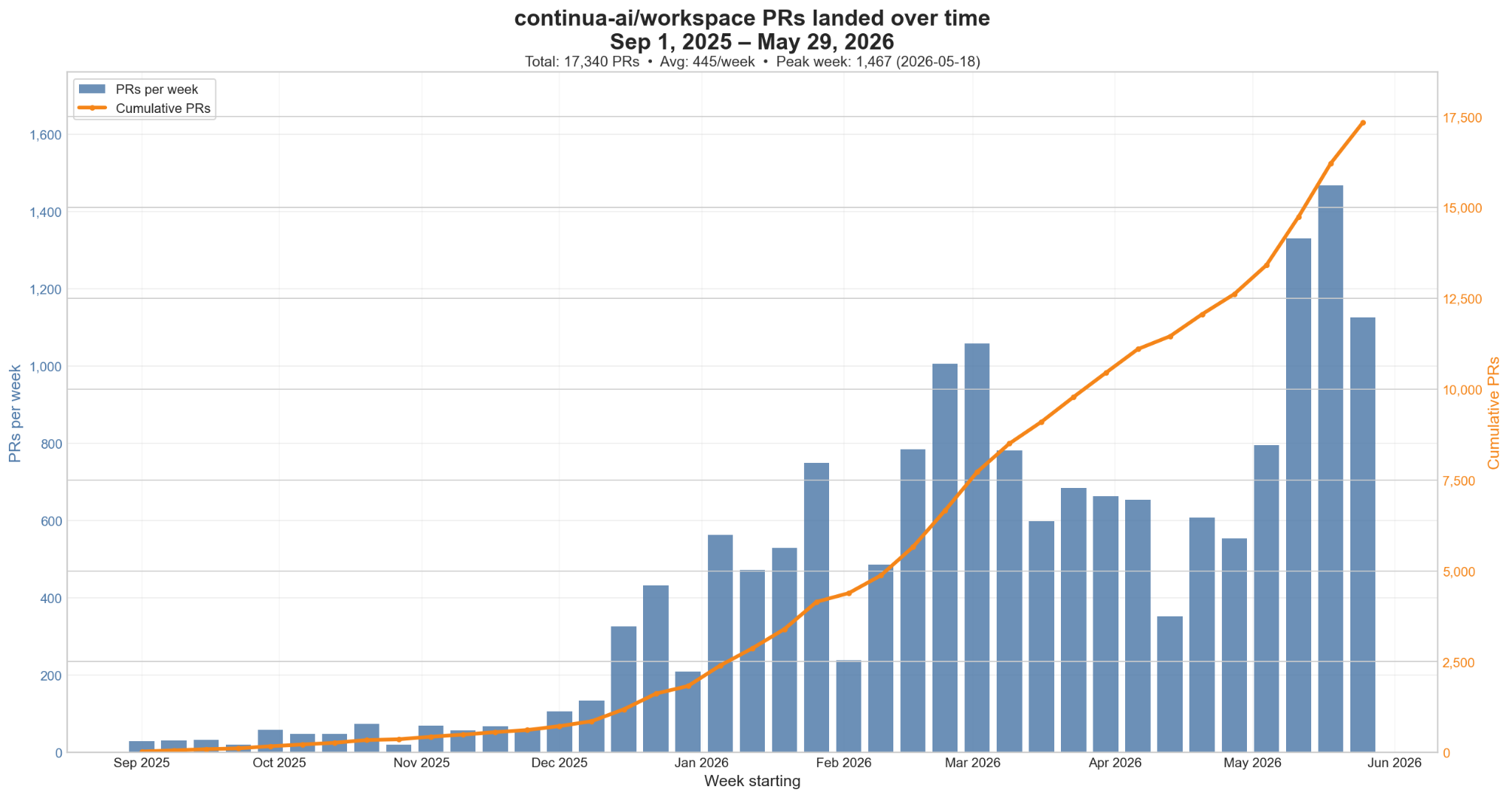
PRs are an imperfect proxy for useful work, but the shape of the curve captures the lived experience: once agents got good, code production stopped being the scarce resource. Coordination, validation, and attention became the scarce resource.
Some of the pieces behind this are not things we’re ready to fully unpack yet. Internally, we think about source control designed around agents: working copies, candidate snapshots, validation evidence. We think about scoped capabilities that let agents safely use services, credentials, browsers, compute, deployment surfaces. We think about making sure agents stop rediscovering the same dead ends and instead share their discoveries. And we think about predicting when work should be parallelized or serialized and detecting stuck agents early.
In classic Valley fashion, we were doing A, then had to solve B to solve A, then decided B is the much bigger and important problem. We’ve shifted from producing our Social AI consumer product to building and offering our coding platform as a B2B and prosumer experience.
Continua’s experience in Social AI is critical to our new direction. Coding is rarely a solo project. We work on teams. In organizations. Our Social AI work taught us that intelligence is not just single-player. The hard parts are etiquette, timing, delegation, privacy, and knowing when to involve which person. Software teams have the same shape: many humans, many agents, private context, shared goals, and a very limited attention budget.
Please visit wheelie.dev and sign up on our waiting list. We’re hoping to get some early explorers to a new way to develop code. Your support and feedback subsidizes our research and development in this exciting area!
In a loop-closing fever dream,